All About Feedback

Updated: Mar 9
We like to think of feedback as a straightforward, rational process: observe, evaluate, share. But in real life, feedback is rarely that clean. It’s emotionally charged, socially risky, and neurologically triggering. If you’ve ever hesitated, softened your message, or avoided giving feedback altogether—you’re not broken. You’re human.
I’m a Coach Who Hates Giving Feedback
People often describe me as direct—sometimes even aggressive. (Honestly, I think it’s more like turtle behavior than lion roar.) And the truth is? I hate giving feedback. I literally have to tell myself to put on my “big girl pants.”
I’m the kind of person who probably would never send back food that was poorly cooked or tasted off. When I notice someone has food stuck in their teeth, I have to pep talk myself into telling them. But why? I’m pretty good at being awkward and putting people in uncomfortable situations—so what about giving feedback makes it so hard for me?
The Feedback Paradox: I Hate Receiving It
The first reason is simple: I’m terrible at receiving feedback.
When I get feedback, it physically hurts. Like, my body hurts. Even though I know it’s a gift, my first reaction is,
“You little sh** — can’t you see all the reasons why this isn’t fair?!”
The piece of work that helped me cope with this pain was an article by Holmer, L. L. (2014), Understanding and reducing the impact of defensiveness on management learning: Some lessons from neuroscience (Journal of Management Education).
Here’s what I learned:
Defensiveness is a natural brain response. Our brain’s amygdala triggers defensive reactions when it perceives threats—social or psychological—like receiving feedback. It’s part of our survival mechanism designed to protect us.
Defensiveness shuts down learning. When defensive circuits activate, the prefrontal cortex—the brain’s center for reasoning and self-regulation—becomes less active. This reduces our ability to process new information, listen openly, and adapt.
Emotional threats feel more urgent than intellectual challenges. The brain prioritizes managing emotional threats over cognitive tasks. If feedback feels like a personal attack, the brain focuses on managing the threat, not understanding the message.
Safe environments reduce defensiveness. When people feel trusted and supported, their defensive responses lessen, fostering learning and growth.
Language and tone matter. Non-judgmental, curious language can reduce amygdala activation and engage the prefrontal cortex, making feedback easier to receive.
Once I understood that my defensiveness was just my body doing its job, I was able to normalize that awful feeling and wait until I could process what was said. I learned to say an automatic, “Thanks for the feedback,” knowing I’d feel gratitude later — just not right then. Right now, I might be pissed, but I knew it wasn’t because the person was trying to hurt me. I just had to take it on the chin, give my emotions time, and later figure out how to use the feedback to grow.
Why Giving Feedback Feels Just as Bad
Okay, so I hate getting feedback. But giving it? That’s still hard.
I used to think I avoided giving feedback because I didn’t want to hurt people. That’s partly true. But underneath it all was something sneakier:
I didn’t want to feel uncomfortable.
I didn’t want to feel awkward, exposed, unsure. I didn’t want to risk being wrong, harsh, or misunderstood. I didn’t want to be the person who made someone else feel the way I feel when I get feedback.
But why is feedback so hard to give — even when we know it’s important?
Because it’s not just a skill issue. It’s a tangled web of psychological, emotional, and social risks:
🧠 Biological Threat
Your brain treats feedback as danger — to connection, belonging, identity. Just thinking about giving feedback can trigger a stress response. Your body tenses. Your thoughts get fuzzy. Your nervous system shouts: “Avoid! Avoid!”
🫂 Relational Risk
Giving feedback feels like messing with the relationship. What if they get upset? What if I ruin the vibe? Especially in fragile or power-imbalanced relationships, we worry: “This might change how they see me.”
😬 Emotional Discomfort, Lack of Skill, and Modeling
You know it’ll be awkward. You’ll fumble your words. You might make someone cry—or cry yourself. So you push it down, telling yourself you’ll say it later. (Spoiler: You won’t.) If you’ve never seen feedback done well or practiced it, why would you think you’d be good at it? Of course we’re uncomfortable when we haven’t invested in the skill.
😕 Doubt It Will Work
Maybe you’ve given feedback before and nothing changed. Maybe you’re skeptical this person can (or will) take it in. You think: Why risk the stress if it won’t even help?
⚖️ Power + Identity Dynamics
Race, gender, hierarchy, neurodiversity — these all influence feedback. A white man giving feedback is read differently than a young Black woman doing the same. Some people get coded as “assertive,” others as “aggressive.” These dynamics are real—and they make feedback riskier for some.
What Happens When We Don’t Give Feedback?
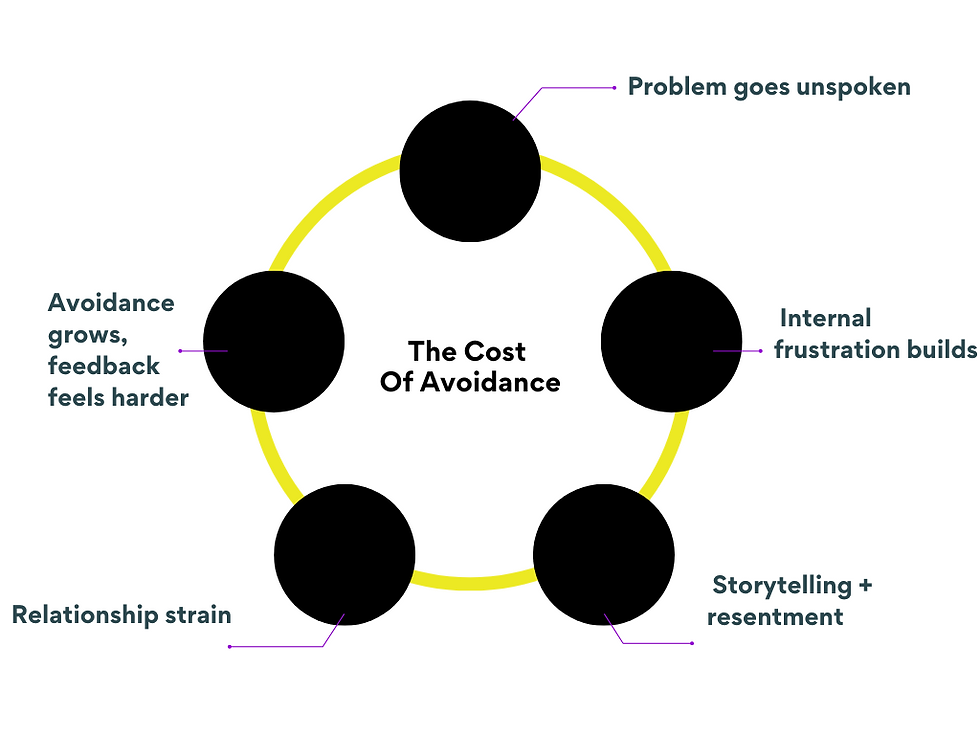
Now that we understand the skills we need to practice, I want you to think about your own reasons for why giving feedback fits with your leadership approach. This starts with understanding the true cost of avoiding feedback.
The truth is, avoiding feedback doesn’t make the issue disappear. Instead, it festers. We build stories. Resentment grows. And we risk the very relationship we were trying to protect.
It might start as a small irritation:
“Why didn’t they respond to my email?”
But without a release valve—a conversation—we keep stewing on it.
Emotionally, it’s like carrying a pebble in your shoe that turns into a blister.
Our brains try to make sense of the behavior — often without the full picture.
We fill in the blanks:
“They must not respect my time.”“They’re lazy.”“They don’t care about the team.”
These are stories — mental narratives we create to explain what’s going on. As humans, we seek explanations and causes to feel more certain and safe.
The kicker? The other person may have no idea any of this is happening.
Eventually, these unspoken tensions show up — just not directly. We might get passive-aggressive, withdraw from collaboration, avoid the person, or explode unexpectedly over something small.
All of this erodes trust. The relationship becomes strained—not because of the original issue, but because it was never addressed.
Avoiding feedback doesn’t preserve the relationship — it poisons it in silence.
Feedback is uncomfortable but necessary. Withholding it is often more about self-protection than care.
Try This Simple Structure (When You’re Ready)
One practical way to give clear, effective feedback is to use the SBI model, developed by the Center for Creative Leadership (CCL). SBI stands for:
Situation — Describe the specific context or when and where the behavior occurred.
Behavior — Describe the observable actions without interpretation or judgment.
Impact — Describe the effect the behavior had on you, the team, or the work.
For example:
“In yesterday’s meeting (Situation), you spoke over Julia three times (Behavior). It made it hard to hear her ideas (Impact).”
The SBI model helps keep feedback factual and focused, reducing the chance that the other person feels attacked or judged. It centers the conversation on concrete events and their effects rather than personality or intent.
This is the SBI part — your view of the situation.
But your view is incomplete. You don’t have access to the other person’s:
Intentions
Experience
Challenges behind the scenes
Giving feedback isn’t just about saying something clearly. It’s about seeing something more clearly—together.
Understand: “What was going on for you?”
This step invites dialogue and perspective-taking. We recognize that we have gaps in what we know and how we interpret things. The person receiving feedback has their own story and intentions.
Instead of just dropping feedback and expecting change, invite dialogue with questions like:
“What was going on for you in that moment?”“How did you see it?”“Did I miss something?”
Understanding doesn’t always lead to agreement, but it closes the gap between intention and impact. Feedback is not a monologue.
Request: “Next time, could we pause and make space?”
This is where many feedback conversations break down. We give observations and invite dialogue but don’t name what we actually need going forward.
End with a clear request or co-create a commitment.
This isn’t about control — it’s about collaboration. It says:
“Here’s what would help next time.”“Could you try doing X instead?”
A good request is actionable, specific, and focused on the future — not punishment for the past.
Remember: You’re not demanding. You’re inviting commitment, showing you believe they’re capable of change and that you’re invested in their success.
This turns feedback into a conversation, not a correction.
Find Your Why
In reality, feedback is a relationship builder and performance multiplier. It does this by:
Fueling growth and learning: Feedback is a moral obligation. Not giving it robs others of the chance to grow. We can’t improve in a vacuum.
Strengthening trust: Contrary to how it feels, feedback signals investment in someone’s growth by caring personally and challenging directly, which drives results.
Clarifying expectations: Regular feedback makes expectations explicit and consistent. When expectations are unclear or evolving, feedback helps clarify the “what” and the “why” behind tasks, behaviors, and goals — reducing misunderstandings.
Building shared standards: When teams give and receive feedback collectively, they co-own what excellence looks like. It’s not just the manager driving quality — it’s the whole team holding itself accountable.
Feedback is hard. It’s uncomfortable. But it’s also necessary. The more we lean into it with curiosity, courage, and compassion, the stronger our teams—and relationships—become.

Comments